
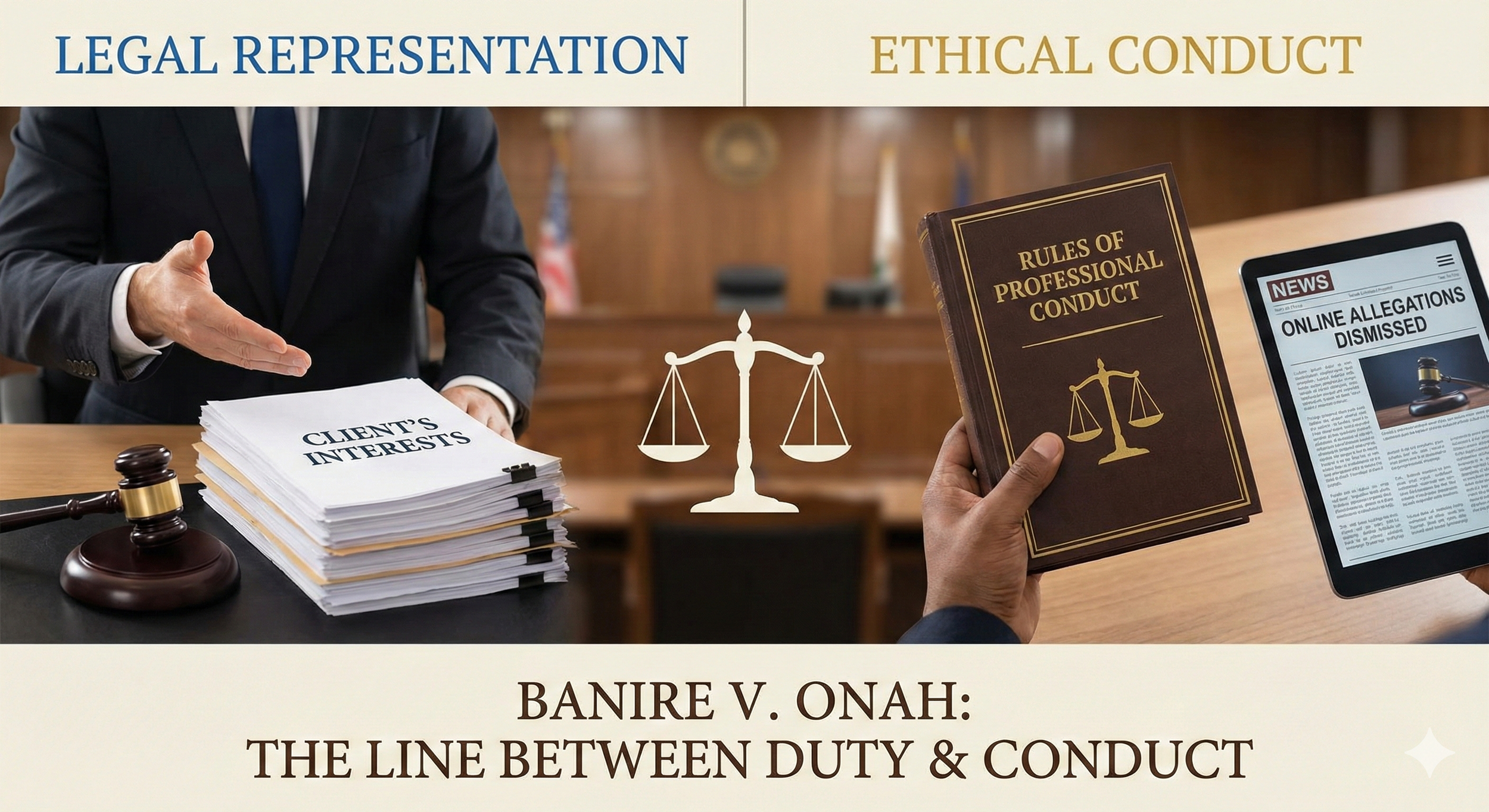
Legal Representation vs. Unethical Conduct: Understanding the Banire v. Onah Decision
The line between Legal representation and “unethical conduct” under the Rules of Professional Conduct ( The case of Banire Vs Onah)
In the legal world, the line between vigorously representing a client and engaging in "unethical conduct" can sometimes become a point of heated contention. A recent ruling by the Legal Practitioners Disciplinary Committee (LPDC) in the case of Dr. Muiz Banire, SAN v. Abah Onah, Esq. (Petition No: BB/LPDC/454/2021) provides a clear look at how the law distinguishes between professional duty and personal misconduct.
The table below summarises the core findings of the Legal Practitioners Disciplinary Committee in the matter of Banire v. Onah (Case No: BB/LPDC/454/2021), focusing on the boundary between client advocacy and professional ethics;
The Dispute: Allegations of Online Defamation
The conflict began in early 2021 when Dr. Muiz Adeyemi Banire, SAN (the Applicant) filed a complaint against Abah Onah, Esq. (the Respondent). Dr. Banire alleged that Mr. Onah had made false, unethical, and derogatory statements about him in various online news publications, including Security Monitor and Opera News.
The Applicant's Key Complaints:
Allegations of Crime: The publications suggested Dr. Banire used his influence to pervert the course of justice and obstruct the wheel of justice.
Safety Concerns: The statements implied Dr. Banire might be responsible for violent attacks by suspected cultists against Mr. Onah and his staff.
Unprofessional Conduct: Dr. Banire argued these statements violated Rules 1, 26(1), 27(1), and 47(1) of the Rules of Professional Conduct, which require lawyers to uphold the rule of law and treat colleagues with respect and fairness.
The Defense: Protecting the Client’s Interest
Mr. Onah, represented by Sir Ejeta Otuoniyo, Esq., argued that the online statements were not unprovoked attacks but rather a necessary response to clarify the legal status of a receivership over 150 plots of land at Alma Beach Estate.
The Respondent's Position:
Counter-Narrative: Mr. Onah claimed Dr. Banire had previously granted a press interview (published in The Punch) where he referred to the police and the Receiver/Manager’s team as "thugs" and "hoodlums".
Professional Duty: As the court-appointed Receiver/Manager, Mr. Onah argued he had a duty under Rule 14(1) to protect his client’s interests and clarify misrepresentations that could negatively impact the receivership.
Context Matters: He maintained that his interactions with journalists were meant to provide court judgments and facts to counter
The LPDC’s Findings: Why the Case was Dismissed
The Committee, led by Hon. Justice Obietonbara O. Daniel-Kalio, ultimately found Mr. Onah NOT GUILTY of professional misconduct. Their decision rested on several critical legal pillars:
The Power of Context (Ex Antecedentibus)
The Committee applied the legal maxim ex antecedentibus et consequentibus fit optima interpretatio, meaning a document is best interpreted by its context. They found that Mr. Onah’s statements did not emerge "out of the blue" but were a response to Dr. Banire’s own published opinions regarding the activities at Alma Beach.
Reported Speech vs. Direct Quotations
A key technicality favored the Respondent: the most damaging statements—suggesting Dr. Banire was responsible for violent attacks—were not in quotation marks in the news articles. The Committee ruled these were "mere written assertions" by the journalists (hearsay) rather than confirmed direct statements from Mr. Onah.
Best Interest of the Client
The LPDC noted that while lawyers must treat each other with respect, they also have a primary duty to act in the best interests of their clients. Responding to public allegations that affect a client’s legal standing is considered a responsible exercise of that professional duty.
| Rule Ref. | Requirement | LPDC Application |
|---|---|---|
| Rule 1 | Uphold the rule of law. | Providing court judgments to the press to clarify a legal position is consistent with upholding the rule of law. |
| Rule 14(1) | Act in the best interest of the client. | A lawyer may respond to public "media outbursts" that threaten their client's legal or receivership interests. |
| Rules 26 & 27 | Treat colleagues with respect and fairness. | A response to a colleague's public criticism is not inherently unfair if it aims to clarify facts in a responsible manner. |
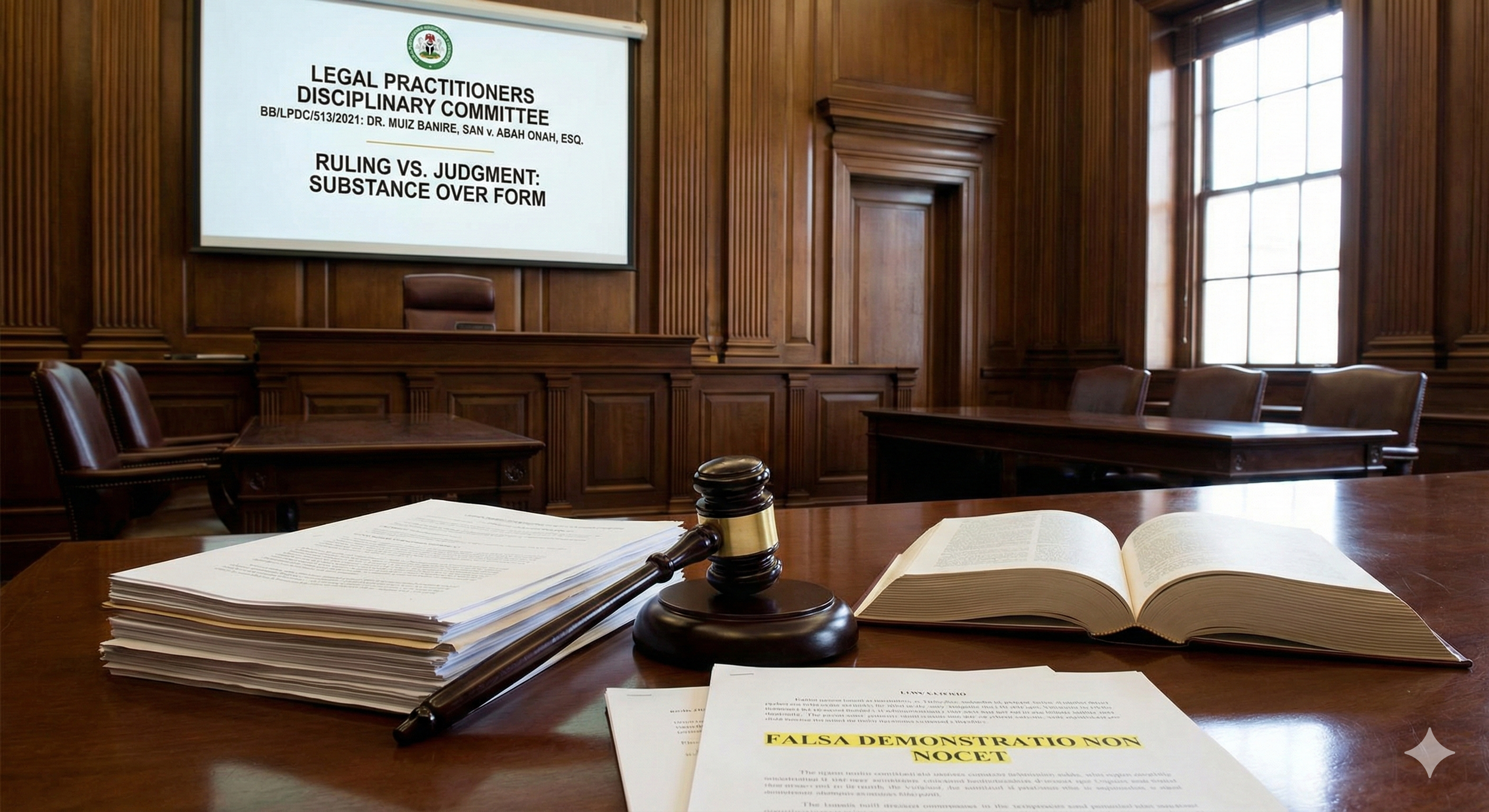
Ruling vs. Judgment: When Labels Don't Limit the Law (The Case of Banire v. Onah)
Is There a Difference Between a Ruling and a Judgment?
In the world of legal technicalities, words usually act as rigid boundaries. However, a landmark decision by the Legal Practitioners Disciplinary Committee (LPDC) recently reminded the legal community that the law prioritizes substance over semantics. The petition, BB/LPDC/513/2021, centered on a provocative question: Is it professional misconduct to call a "Ruling" a "Judgment"?
The Bone of Contention
The dispute began when Dr. Muiz Adeyemi Banire, SAN (the Applicant), filed a complaint against Abah Onah, Esq. (the Respondent).
The allegation was serious: Fraudulent Misrepresentation. The Applicant contended that Onah, acting as a Receiver/Manager, instructed a solicitor to register a document at the Lagos State Lands Registry. While the document was officially titled a "Ruling" by the Federal High Court, Onah's letter of instruction referred to it as a "Judgment."
The Applicant's Argument:
By labeling a Ruling as a Judgment, the Respondent allegedly misled the Registrar of Titles.
This act was framed as a manifest desire to deceive, violating Rule 15(3) of the Rules of Professional Conduct (2007).
The Applicant claimed this was a "smuggling" operation to register unregistered survey plans.
The Defense: Substance Over Form
Represented by Sir Ejeta Otuoniyo, the Respondent argued that the fuss over the title was legally misplaced. The defense rested on the nature of the court's decision rather than its heading.
Finality: The "Ruling" in question (delivered by Hon. Justice Obiozor) was a "considered ruling" that finally determined the rights of the parties regarding charged assets.
Legal Precedent: Citing Akinsanya v. UBA Ltd (1986), the defense argued that the substance of a decision determines whether it is a Judgment, not its title.
No Intent to Deceive: The Respondent maintained he verily believed the Ruling was a final judgment in nature.
The LPDC’s Verdict: Falsa Demonstratio Non Nocet
The Committee, led by Hon. Justice Obietonbara O. Daniel-Kalio, dismissed the allegations of misconduct. Their reasoning provides a masterclass in legal interpretation.
The Power of the Maxim
The Committee invoked the legal maxim "Falsa demonstratio non nocet"—a false description does not deviate or vitiate.
"An erroneous description of a person or thing does not necessarily destroy the effect of an instrument. That a table is labeled a chair, for example, does not make the table a chair simply because it is labeled as a chair."
The Test of Finality
Following the "Bozson Test," the Committee asked: Does the order finally dispose of the rights of the parties? Because Justice Obiozor’s Ruling determined that the parties had no locus standi or legal capacity regarding the assets, it was, for all intents and purposes, a final order.
Statutory Context
The Committee clarified that Section 58 of the Lagos State Lands Registration Law does not restrict registration to documents strictly titled "Judgment." Since the law allows for the registration of "every document of interest or title to land," the Ruling qualified perfectly.
Key Takeaways for Legal Practitioners
| Principle | LPDC Finding |
|---|---|
| Nomenclature | The Committee held that the substance of a Court's decision, not its form or title, determines whether it is a Judgment or Ruling. If an order finally disposes of the rights of the parties, the nomenclature "Ruling" is not the determinant in concluding it is not a Judgment. |
| Professional Conduct | The Respondent was found not liable for professional misconduct. Referring to a Ruling as a Judgment in a letter to the Lands Registry does not constitute fraudulent misrepresentation if the decision is final in nature. |
| Statutory Interpretation | Provisions must be construed with reference to the whole statute. Section 58 of the Lagos State Land Registration Law does not state that only a "judgment" can be accepted; every document of interest in land is registrable. |